In default WordPress settings, category URLs include a “category” prefix. Some users find this prefix redundant as it makes URLs unnecessarily long. Consequently, many look for ways to remove it. Before deciding if this approach is right for you, let’s introduce two plugins that can help: Remove Category URL and No Category Base (WPML).
Remove Category URL
Remove Category URL is a lightweight plugin whose primary function is to remove the “category” prefix from WordPress category pages’ URLs.
Key features:
- Simplicity: No configuration required after installation.
- Automatic Redirection: Handles redirects automatically to ensure old links remain valid.
- Compatibility: Compatible with most themes and plugins.
- Regular Updates: Maintained to support the latest WordPress versions.
No Category Base (WPML)
No Category Base (WPML) not only removes the “category” prefix from category URLs but also provides more functionality, specifically supporting Multi-site and WPML.
Key features:
- Removes the “category” prefix from category URLs.
- Supports WPML multilingual plugins.
- Provides options for custom URL structures.
- Includes 301 redirection functionality.
- Supports subcategories.
- Supports Multi-site environments.
That said, both plugins can achieve the goal of removing the category directory URL prefix, but is it worth doing? Are there potential issues?
Manual Method: Removing Category URL Prefix Without Plugins
Besides using plugins, you can set the category base in WordPress settings to “.”. This way, when WordPress parses the URL, it will ignore the “.”. Simultaneously, you might need to add “.html” to your custom permalink structure for posts to maintain proper resolution in some older configurations, though modern setups often handle it gracefully with just the dot.
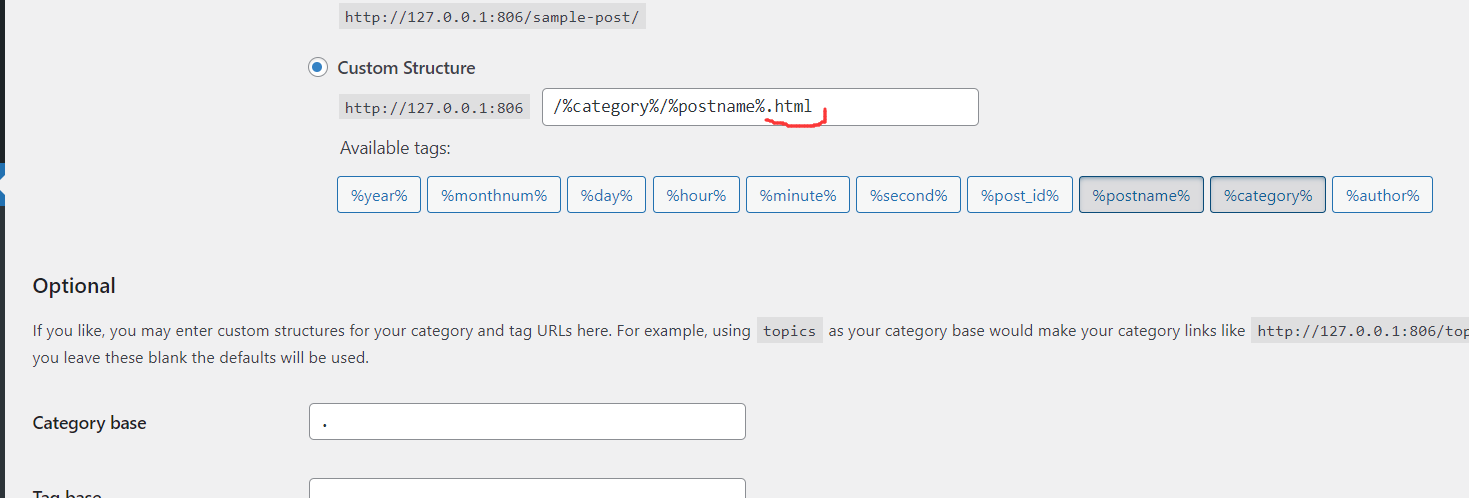
Potential Issues with Removing the “category” Prefix
Removing the “category” directory from WordPress category URLs can indeed bring some potential drawbacks. Let’s look at several key points:
- Potential URL Conflicts: If your post or page URL is identical to a category slug, WordPress might default to displaying the post or page instead when visiting that URL.
- SEO Impact: If your website is already live and has a significant amount of content, modifying URLs can impact SEO. Even with 301 redirects, a large volume of URL redirections can lead search engines to decrease their trust in your site’s stable architecture.
- Reduced Identifiability: The “category” prefix in the URL allows users to quickly identify it as a category page. After removal, it might reduce the semantic clarity of the URL, making it harder for users to distinguish between category archives and individual status pages.
- Plugin Compatibility: Some plugins might rely on standard WordPress URL structures. Changing this structure could cause certain plugin functionalities to become abnormal.
Purely from a technical perspective, removing the “category” prefix might present these issues. However, with reasonable planning and testing, we can minimize the possibility of these issues occurring.